You can Download the Article with Photos below
Articles and Loft Reports
Barry Trewin
Articles
5 Minutes with Barry Trewin (2004)
British Homing World - Baz Ashcroft
Where's Barry (2004)
Pigeon Manure - Great Fertilizer
Interesting Facts about Pigeons
Benefits of Pigeons on Mental Health
Pigeons - A Billion Dollar Industry
Why Don't people know about racing Pigeons?
Changes over the last 100 years!
Does Colour Affect Performance
NEW Articles - Coming Shortly!
The Moon and its Phases
Peregrine Falcons
Road Training
Sprint and Distance
The Sun
Loft Reports
Trewin in the Coalfields – NSW
Other Articles of Interest
Articles
The Mystery of the Racing Pigeon - Amanda Smith ABC
The Mallee Classic 2000 - Wendy Hersey
Ken Roberts - SA - Rob Caesarowicz
Competence - Alf Del-Brocco QLD
Mallee Classic OLE in the Media
Marathon Lofts. Willi Netzer - Thailand
Rats of the air or heroes of war. The surprising history of pigeons ABC
Nockatunga 700 Mile National Race 2000
Mark Lyfords - UK BHW Article April 2019
Mark Lyfords - UK BHW Article May 2019
The Sky Whisperer of Mackay:
Ted Lewis, Among the Pigeons
By Barry Trewin
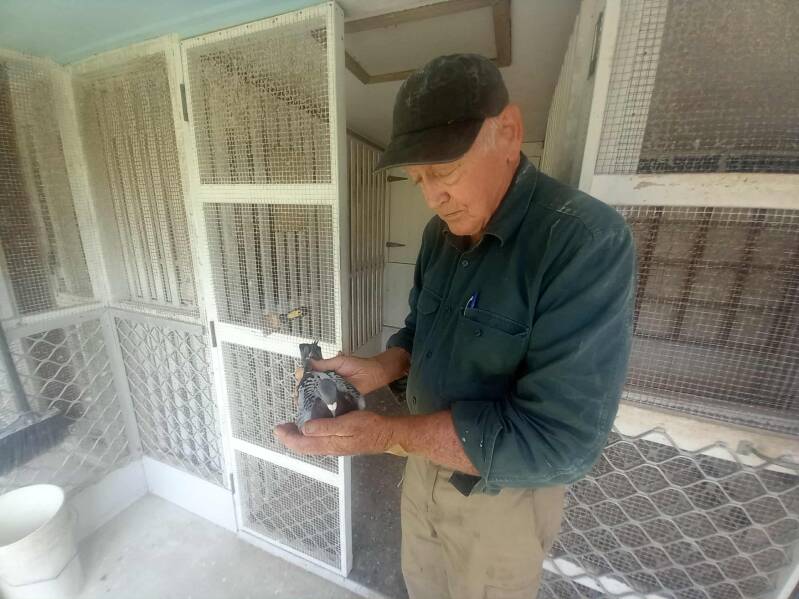
In the warm, salt swept air of Mackay, Queensland, a quiet legend of the pigeon world lives a life guided by feathers, sky and instinct. Ted Lewis, known affectionately among fanciers as the Patron of the Windorah, has spent over six decades with the birds.
I met Ted thanks to Mike Young, who’d invited me north for the Windorah Combine presentation night at Sarina Beach. Between the ocean breeze and the laughter of pigeon men swapping race stories, Ted has that unmistakable mix of country common sense and deep intuition, the kind that can only be shaped by years watching wings cut through the sky.
Loft Report – Ted Lewis (Mackay, Queensland)
Ted Lewis is a long standing member of the Mackay pigeon racing community and is well respected as the Patron of the Windorah Combine. His practical experience and balanced outlook have made him a key figure in the region’s small but active racing scene. This report was compiled following a visit arranged by Mike Young during the Windorah Combine presentation night at Sarina Beach. Ted welcomed the opportunity to share his methods and experiences developed over many years in the sport.
Background
Name: Ted Lewis
Location: Mackay, Queensland
Club: Mackay Group – 13 members
Combine/Federation: Windorah Combine – 5 members (as not all compete)
The Windorah Combine operates on a simple, common-sense approach with minimal rules. Members focus on results and fair racing under local conditions rather than rigid regulations. It is more about the comraderie and pigeons than stead fast rules.
Getting Started in Pigeons
Ted’s interest in pigeons began early. “I liked birds and would see pigeons on the streets while going to school, so I started to collect them,” he said. His racing career began around 1960 after witnessing a memorable flight. “I saw some pigeons very high up, spiralling down to a loft, it was a real spectacle,” Ted recalls. He started with strays no one wanted and ended up beating other flyers.
He was guided in his early years by older fanciers Russell Beatham and Jimmy Bell. “They would try and give advice and helped along the way,” Ted says, crediting them with his early understanding of pigeon care and racing preparation.
Strains and Breeding
Ted has maintained several family lines over the years. “I had the old Brisbane lines, and those old lines are very hard to find now, most are nearly gone,” he said. “My Goodgers have been best in recent times and I’ve also bred my night birds. Their youngsters breed as good as the parents.”
He also keeps a strong Kruger cock bird whose offspring perform best in the 300 to 400 mile races. “His youngsters can’t win the 500 mile races, but they’re very good at middle distances,” Ted explained.
When breeding, Ted focuses on pairing quality birds together. “I breed good pigeons to good pigeons; otherwise, you’re wasting your time,” he said. He generally pairs birds in June or July, at the end of the racing season.
Ted also notes interesting breeding observations. “I had a hen, and I found her first round was always the best,” he said. When asked about the ideal pigeon, Ted’s answer is practical: “I’m yet to find the perfect pigeon, but when I do I’ll let you know. They’ve got to look right, have the usual good traits, and no washed out eyes. Unfortunately, plenty of the old Janssens had washed out eyes.”
Stock and Numbers
- Stock Pairs: 12
• Young Birds at Start of Year: 70
Feeding
Ted mixes his own grain blend and adjusts it depending on the season and weather. “I like to include a bit of small seed,” he said. “I feed twice a day and the birds always get plenty.”
He believes in keeping feeding simple and consistent. “The best thing is to give them picking blocks,” Ted added. For race preparation, he changes the mix based on distance. “For sprint racing, I’ll feed lighter. For distance events, I increase maize and add extra oil and small seeds. I used to give peanuts, but they just make them fat and they’re too expensive now.”
Training Routine
Ted’s training is based on steady, consistent flying and observation. “I like my birds flying for about an hour around the loft, ranging out,” he explained. “As the season goes on, they fly less, so I’ll lock them down for a couple of days to pick them back up.”
He begins tossing from Sarina, around 30 km from home. “My old pigeons might have six tosses before the first race, but the new ones need more—sometimes up to ten,” he said. Ted doesn’t single toss his birds. “It could help make them more independent, but it’s too much trouble,” he said. “I usually toss with others to educate the pigeons.”
He prefers to race both old birds and young birds but notes that his young birds have been particularly competitive lately. “They seem much keener,” Ted said. “My hens usually do better than the cocks overall.”
When selecting birds for races, Ted relies on close observation. “I like to watch the pigeons and see how they’re performing,” he said. “Even if they’re just behind the leaders at 300 miles, they can still shine later.”
Performance Highlights
Ted’s record includes numerous wins and consistent results over decades of racing:
- Won ten races straight against twenty flyers in one season.
• Sent one pigeon to the Windorah long race, got him home and won the prize.
• Six pigeons returned in the night from the Goondiwindi race.
• Third in the Bundaberg One Loft Race and strong result in the Ipswich OLR.
Ted considers the night returns among his most satisfying achievements. “When you get pigeons home in the dark, it’s something special,” he said.
Medication and Health
Ted prefers minimal medication. “I don’t really worry about that,” he explained. “I’ll use it if needed, but I try not to. I also don’t bother much with supplements because I don’t know how they’ll respond.”
Loft and Conditions
Ted’s loft design is practical and suited to Mackay’s coastal climate. He uses a flying and drop trap at the back of the loft and has a clear view of the front area where he can watch arrivals. “I’ve got an area across from the loft where I sit and wait for them,” he said. The Mackay area is mostly open terrain near the coast and weather can vary from humid to windy. Ted adapts as needed and says the local climate doesn’t cause major problems.
Views on the Sport
Ted believes the biggest challenge facing pigeon racing is attracting and supporting new members. “The biggest challenge is to attract new members,we need to look after and help them in the sport,” he said.
He stresses the need for balanced, practical leadership. “We need level headed blokes,” Ted said. “There are always ups and downs and people need to understand it’s hard work and nothing comes easy.”
For newcomers, his advice is clear: “Try to create a family of good pigeons and weed out the ones that aren’t any good.”
Ted also believes in promoting the positive side of pigeons to the public. “People can release white pigeons at weddings and funerals, it’s a good way to show our pigeons in a different light,” he said.
Final Note
Ted Lewis represents the traditional, down to earth side of Australian pigeon racing. His success has come from consistency, observation and good management rather than modern systems or heavy medication. He continues to race and breed from his Mackay loft, keeping the sport alive through steady dedication and a clear understanding of what makes a good pigeon. He has done exceptionally well given that he has regular Dialysis treatment each week which means he doesn’t have as much time as he would like with the pigeons. It was a pleasure to sit and talk with Ted and we wish him all the best and thank him for his time.